
May 20, 2026
Most “best things to do in Bucharest” lists you’ll find online are honest attempts, written by people who spent a few days here. They are not wrong. They are also more or less interchangeable. After fourteen years of taking guests around this city, the list I would actually write keeps roughly two-thirds of the standard answers, adds a third that almost no list has, and quietly skips one or two items the standard lists unanimously oversell.
The famous ones, with caveats
The Palace of the Parliament is the building everyone has heard of — Ceaușescu’s civic-centre megastructure, the second-largest administrative building in the world by floor area, finished in 1997 after the man it was built for had been dead for eight years. Tick it off. But: go look at the exterior, take the photo from across Bulevardul Unirii, and decline the interior tour. The interior is enormous, mostly empty, and the guided visit is exhausting in a way that doesn’t reward the time. The building’s real story is told from the outside — the destruction of the Văcărești neighborhood, the architectural language of pretend-classicism, the scale itself. The interior is just rooms.
The Old Town (Lipscani) has the city’s best concentration of Belle Époque facades, plus Stavropoleos Monastery — a tiny eighteenth-century Orthodox church that is one of the loveliest five-minute visits in Bucharest. The catch is that the Old Town has become a nightlife district. It is genuinely pleasant until about 6 pm and progressively less so after that. Go in the morning. Bring a camera. Don’t eat there; see the food guide for why.
The Romanian Athenaeum (1888) is the most beautiful interior in Bucharest. Built in Beaux-Arts style with a domed concert hall painted with a fresco history of the Romanian people, it is also the home of the country’s main symphony orchestra. The visit during the day is fine. A concert in the evening is the thing. Tickets for circle seats are about €15–25 and the building during a performance feels like it was made for that exact purpose, because it was.
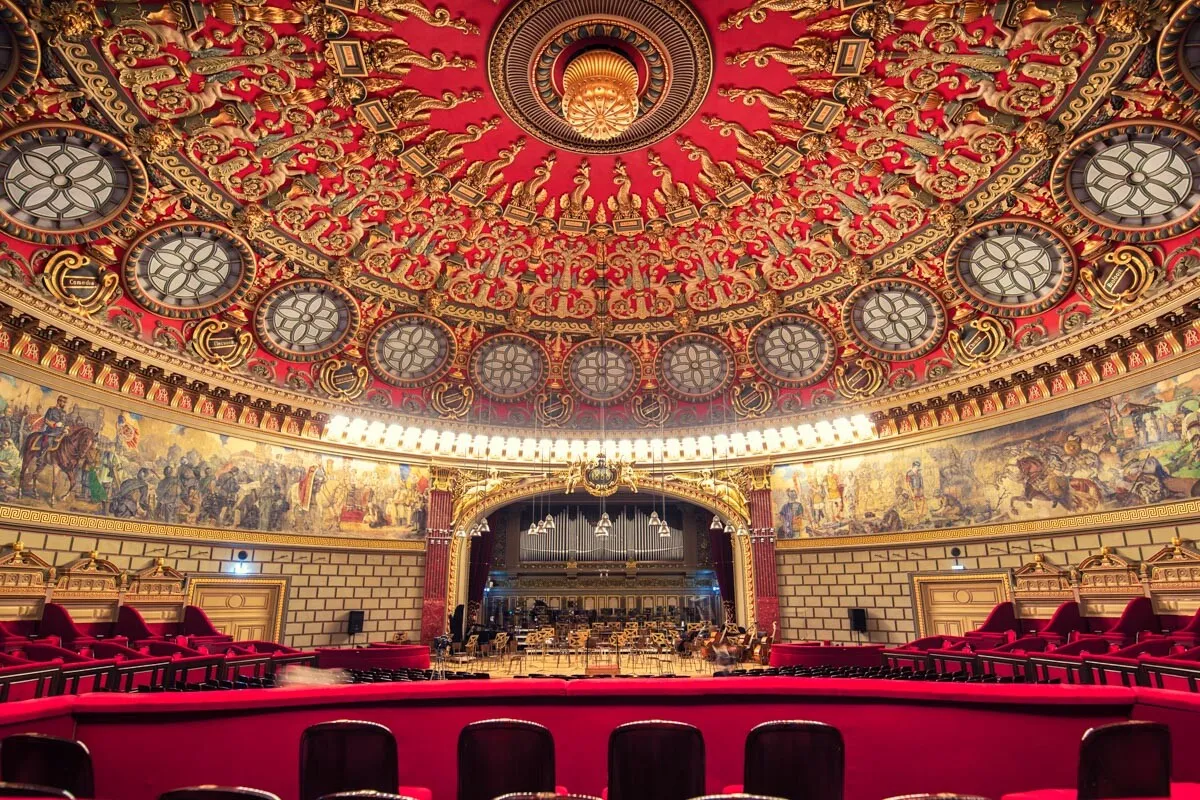 The Athenaeum concert hall — the right way to spend one of your evenings in Bucharest.
What the lists keep missing
The modernist architecture walk on and around Magheru Boulevard is the underrated activity in central Bucharest. Between roughly 1933 and 1940, a generation of Romanian architects — Horia Creangă, Duiliu Marcu, Marcel Iancu, Arghir Culina — built one of the largest stocks of inter-war modernist apartment buildings in Europe. Most are still lived in. Most are neglected to varying degrees. Almost no foreign visitor knows they exist. An architecture historian could spend a full day on Magheru alone. Even thirty minutes walking with a guide who can point them out will change how the rest of the city looks to you — the full Art Deco piece goes building by building.
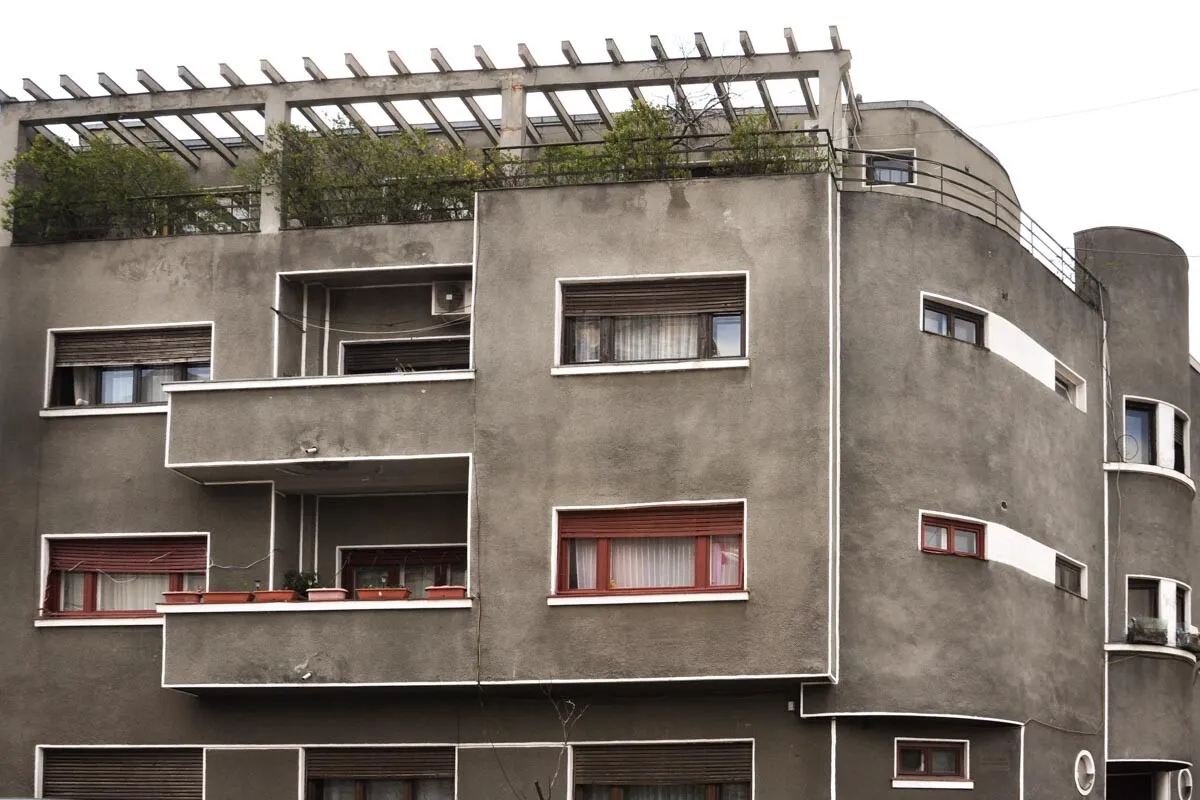 David Haimovici Building (Marcel Iancu, late 1930s) — one of about forty he designed in this city.
Cărturești Carusel — the white-marble bookstore in the Old Town in the restored Chrissoveloni Bank building — is on most lists, but always as a photo op. It is also a working bookstore with a solid English section on the upper floor and a quiet café on the top level that is one of the better places to take a break from the Old Town crowds.
Cișmigiu Gardens is the 1854 city-centre park most tourists never enter even though they walk past it. Oldest park in Bucharest, paddleboats on the lake, surprisingly good benches, and on weekends full of locals doing weekend things. Worth a slow forty-five minutes through.
A Sunday morning at Piața Obor — the working market on the east side of the centre — is the city at its rawest and most cheerful. The mici stand on the perimeter has been selling grilled minced-meat rolls to the same customers for decades. Cash. Go early.
A play at the State Yiddish Theatre is one of the unexpected highlights for visitors with any interest in the city’s Jewish heritage. Performances are subtitled. Tickets are inexpensive. The theatre is one of a small number of continuously operating Yiddish-language stages still in the world. (Separate post on Jewish heritage.)
The Jewish heritage half-day walk itself — Choral Temple, Great Synagogue, Yiddish Theatre, with the lost Văcărești neighborhood explained on the way — is worth a half-day if you have any interest in twentieth-century European history.
Day trips that are actually worth it
Peleș Castle in Sinaia — about two hours north of Bucharest in the Carpathian foothills — is the day trip everyone does, and it deserves the standing. The German-Italian Neo-Renaissance summer residence of the Romanian royal family is one of the most beautifully preserved royal interiors in this part of Europe. One of our 2025 guests from Sighișoara wrote in his review that “the mix of German and Italian Neo-Renaissance styles is eye-catching” and that is exactly the right summary. Combine it with a short stop at Bran Castle if you want the Dracula photograph; be warned that Bran itself is much less impressive than its reputation.
A village day — out into the foothills with lunch in a local home, an hour or two of countryside, a horse-cart ride through the village — is the trip most lists do not even know to offer. We have run it for years; the guest reviews mentioning this trip are uniformly the ones that say “this was the highlight.” Not because the castles aren’t worth it. Because the village experience is what you cannot do anywhere else in Europe.
What to skip, honestly
Skip the “Communist Bucharest” gimmick walking tours that lean heavily on visual repetition (the same five concrete blocks photographed from eight angles). The communist period is fascinating, but it is better understood as a thread through a normal city tour than as a separate themed one.
Skip anything Dracula-themed in the city. Bucharest has nothing to do with Bram Stoker’s novel and the gimmicky bars and “vampire museums” are pure tourist trap.
Skip the after-dark Old Town bar crawls pitched on Lipscani by booze-fueled walking guides. They are the same in every Eastern European capital and they belong in a different post.
Skip trying to do the Parliament interior tour, the Athenaeum guided tour, the Village Museum and a day trip on the same trip. Two of those at most.
The honest summary
Bucharest is a city of small things. The big famous monuments are the things every list mentions; they are fine, you will see them. What ends up making the trip is what happens between them — a five-minute candle in Stavropoleos, a half-hour in front of a 1937 apartment building most tourists walk past, a Sunday morning in a working market, an unexpected evening in a Yiddish theatre. The lists rarely capture those because they are not photogenic in a single frame. They are the reason people come back.
If you would like help finding them, we’d be glad to walk you through any combination.