
May 26, 2026
Everybody talks about Bucharest’s Belle Époque — the Little Paris years, the Athenaeum, the eclectic mansions with their stone caryatids and their wrought iron everything. Almost nobody talks about what came next, which is a shame, because for about eleven years between the two World Wars this city was quietly producing some of the best Art Deco and early modernist architecture in Europe.
I’m biased, of course (Laura more than me — she has been guiding architecture tours here since before I knew her), but walk down Magheru on a low-sun afternoon, look up past the satellite dishes and the cigarette ads, and the case sort of makes itself. You see curved corners, porthole windows, horizontal banding running across whole blocks of apartments, ribbon balconies that wrap around the edge of the building like they were carved out with a single cut. It’s a strange feeling — half of those buildings are tired, water-stained, with a red dot on the door (more on that later), and yet the lines are so confident, so unmistakably modern, that you understand immediately what their architects were trying to do, even ninety years later.
The eleven good years
Romania between the wars was, briefly, doing very well. Greater Romania had just doubled in size after 1918. The oil at Ploiești was being pumped out by foreign companies at a colossal pace. King Carol II came back from exile in 1930 — vain, slightly ridiculous, but also (and this is unfair to say but true) a king who genuinely liked modern things. Bucharest had a growing professional middle class, a lot of it Romanian-Jewish, who wanted to live in apartment buildings, not in the old courtyard houses of their grandparents. They wanted elevators. They wanted hot water. They wanted, most importantly, to live in something that looked like it belonged to the twentieth century.
So between roughly 1929 and 1940, the city tore down a lot of its low Belle Époque streetscape and built, in its place, an entire boulevard’s worth of Art Deco and what would later be called modernism romanesc — Romanian modernism. The architects were young. Most had studied in Paris, some in Berlin, a couple in Zurich. They came home and built almost nonstop until the war stopped everything.
Magheru is the museum
The boulevard now called Magheru-Bălcescu-Brătianu — a single straight kilometre and a half running north-south through downtown — is, depending who you ask, either the densest concentration of interwar modernist architecture in Europe or merely one of the densest. I’ll let other people fight about it. What is not in dispute is that if you stand at Piața Romană and walk south, almost every other building you pass is from the 1930s.
A few of my favourites, in walking order:
Hotel Ambasador (Magheru 8-10, 1937) — Arghir Culina. The man could not lay a brick wrong. The Ambasador is a study in horizontal sweep — long ribbon windows, a setback top floor that gives it the silhouette of an ocean liner, a sign on top that has been there long enough to be a landmark in its own right. The hotel is still operating. Walk into the lobby pretending you are a guest and look at the original terrazzo. Nobody will stop you.
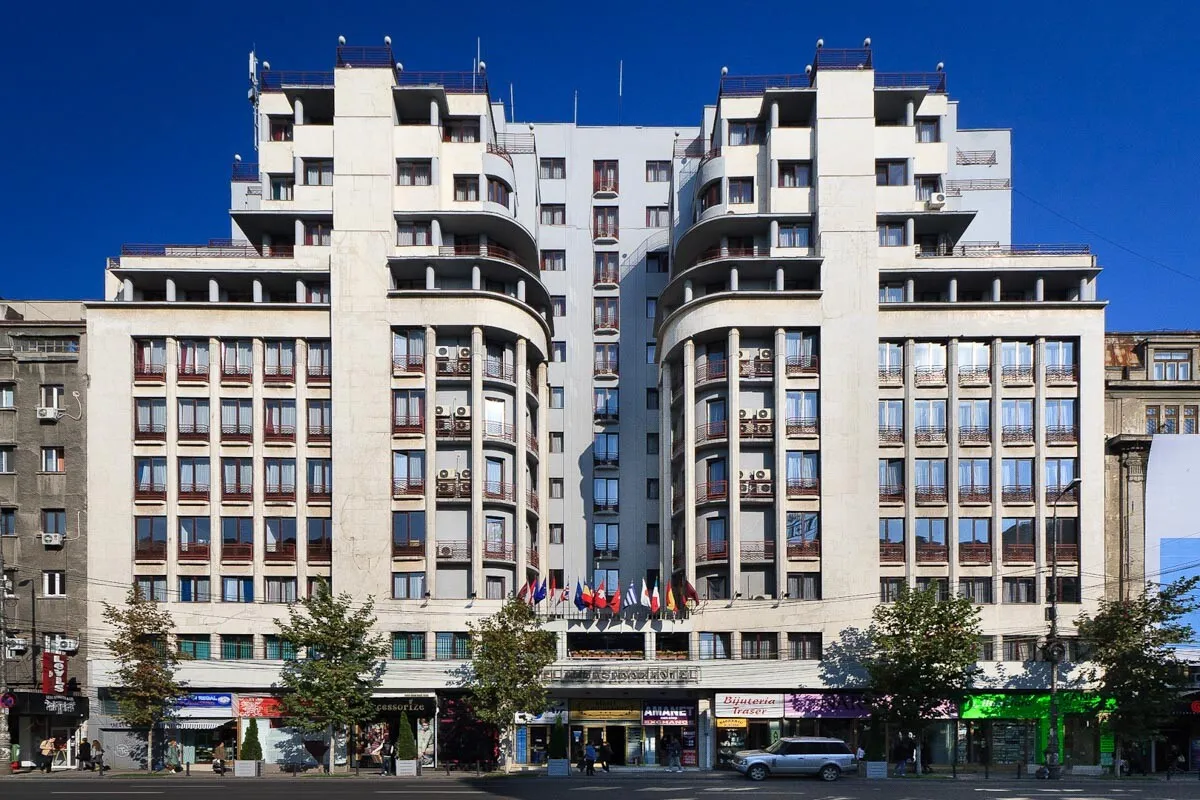 Hotel Ambasador (1937) — Arghir Culina's masterpiece
The ARO Building (Magheru 12-14, 1929-1931), known today as the Cinema Patria — Horia Creangă. This is the one. If you only see one building in Bucharest, see this one. Built for an insurance company in three years flat, it was the first really uncompromising piece of modernism in the country: no Art Deco ornament, no concessions to passers-by, just a stack of pure horizontal volumes wrapped around a corner like a ship’s prow. People hated it when it opened. Now there’s a campaign to get it on the UNESCO list.
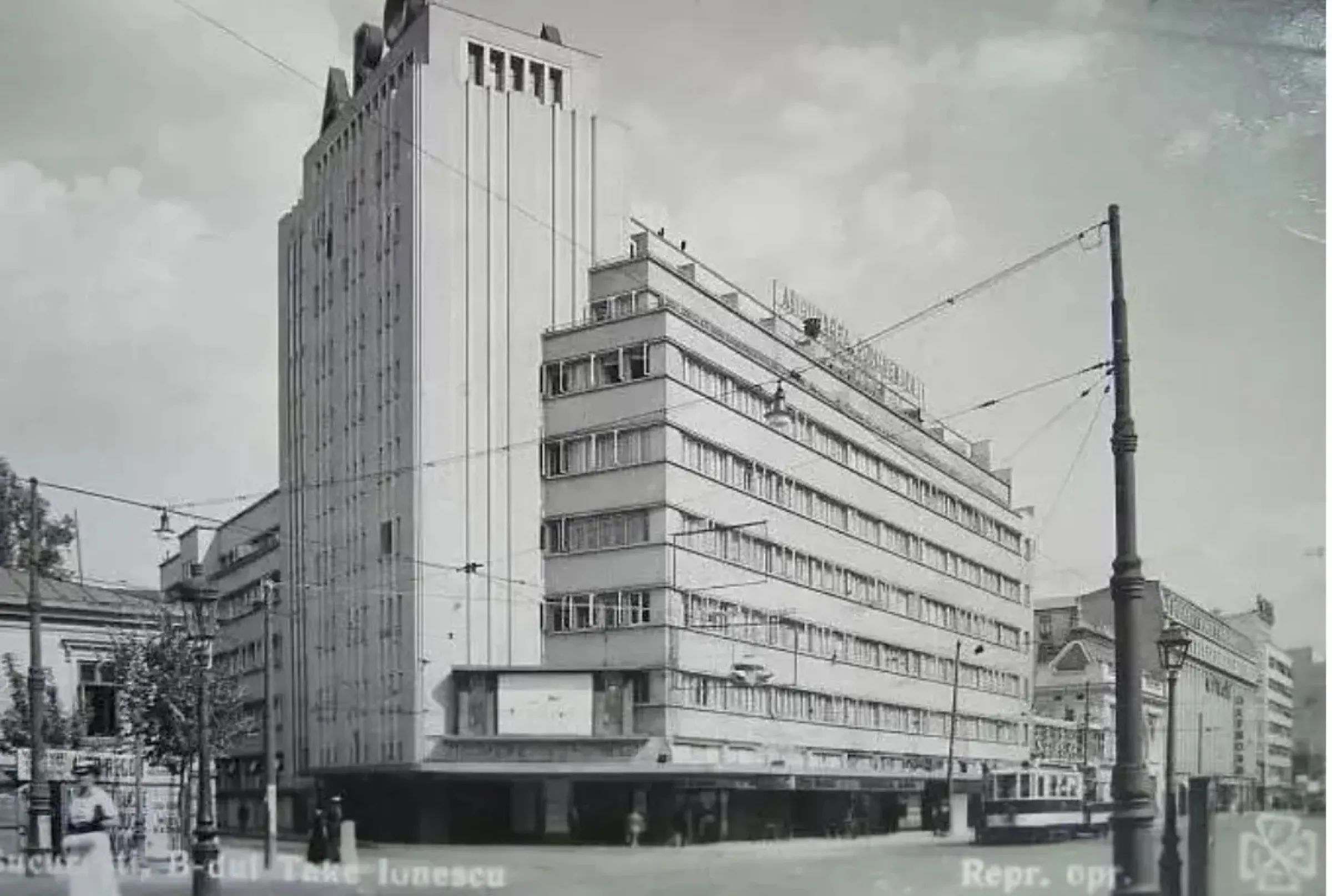 The ARO Building shortly after completion — then on Boulevard Take Ionescu, now Magheru
ArCuB (Strada Batiștei 14, late 1930s) — step off Magheru for a single block to the east and you find one of the cleanest small Art Deco buildings in the city, today housing ArCuB, the cultural centre of Bucharest City Hall. The corner volume carries a vertical glazed bay with a row of porthole windows at the top and “ARCUB” picked out in stylised lettering running straight down the front. It is a compact, confident piece of Streamline Moderne — proof that the good stuff doesn’t always sit on the main drag, and worth the two-minute detour even if all you do is stand on the opposite pavement and admire it.
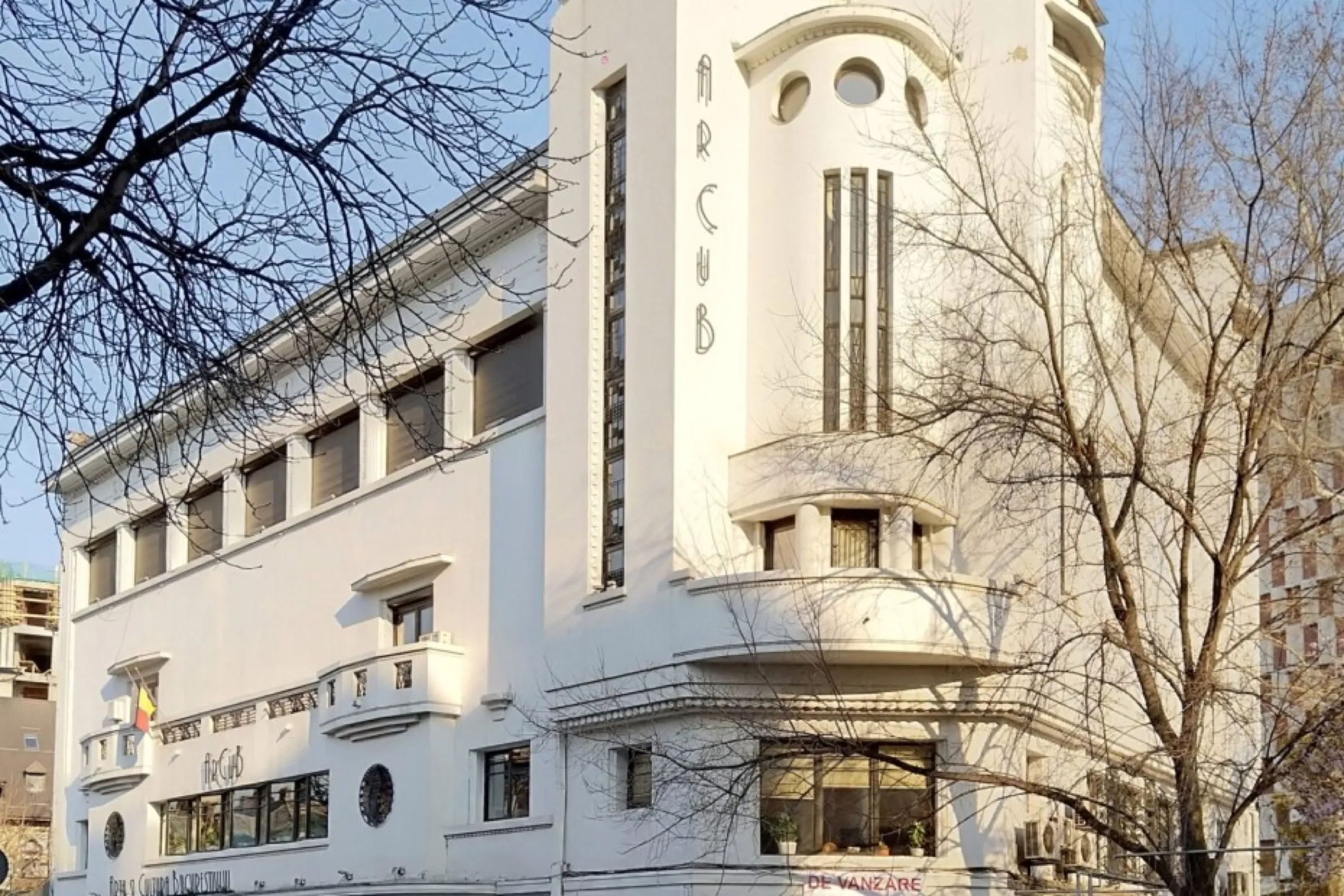 ArCuB on Strada Batiștei — one block east of Magheru, and one of the most photogenic small Deco buildings in town
Magheru One — the Jawol Building (Bulevardul Magheru, late 1930s) — for a long stretch after 1989 this was the boulevard’s saddest building: quasi-abandoned, the modernist facade swallowed whole by giant advertising mesh, the kind of structure you walked past for ten years without realising there was actually a building behind the billboards.
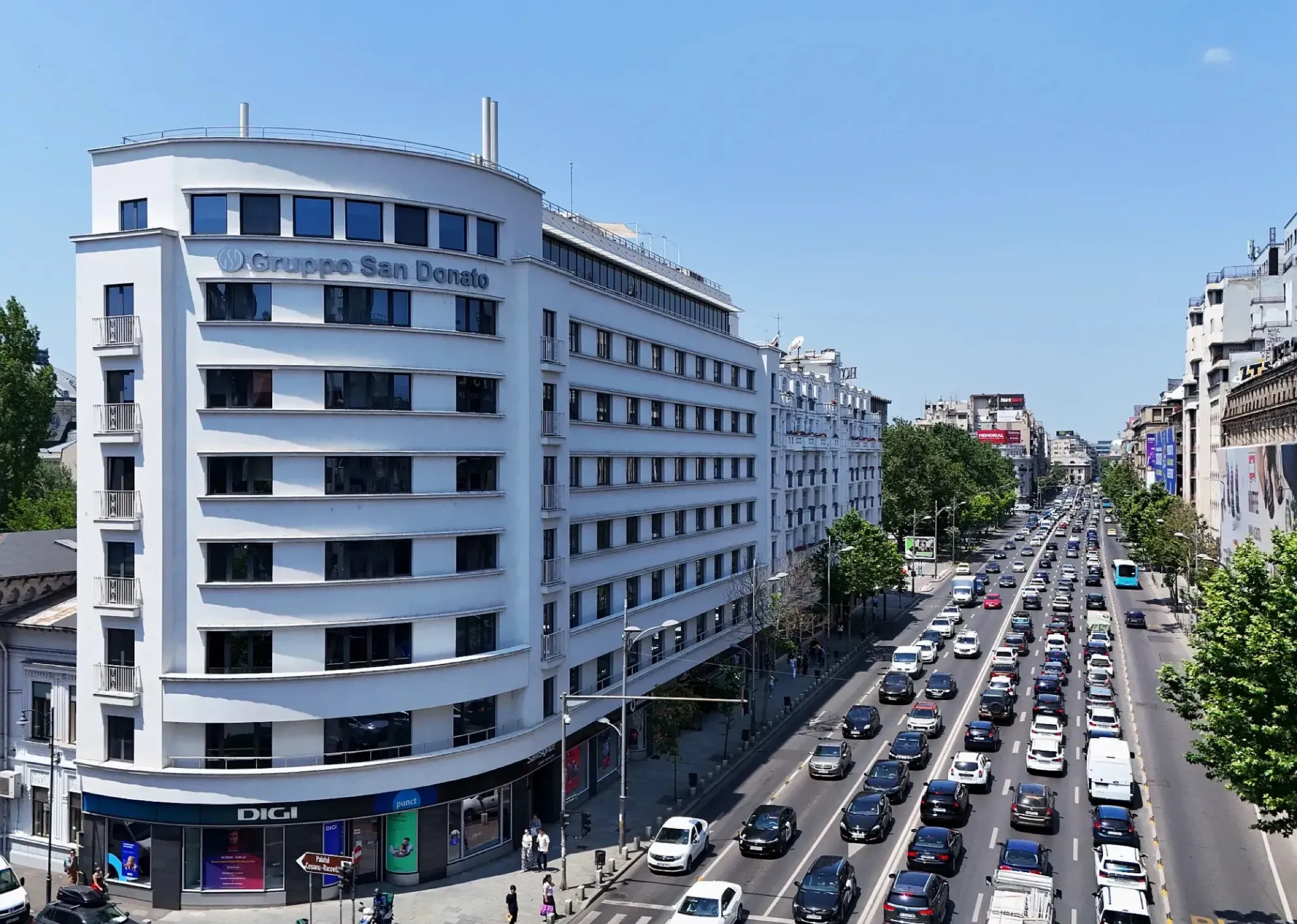 Magheru One — the former Jawol Building — looking south down Magheru after the 2011-2012 restoration. The boulevard's poster child for what good restoration looks like
It sits right next to the old Scala cinema; the two of them used to “guard” this stretch of Magheru in interwar photographs, and a well-known 1944 shot frames a Soviet soldier at the intersection between them — the Jawol behind his left shoulder, the Scala behind his right. Restored properly in 2011-2012 by the current owners, it is now one of the cleanest interwar facades on the boulevard — and a useful reminder that everything on Magheru looked like this once, before forty years of grime, and could look like this again. The building was named after its original tenant, in the same brash commercial-naming tradition the boulevard specialised in — the Wilson, the Scala, the Belvedere, the Casata, all of them up in roughly the same five-year window.
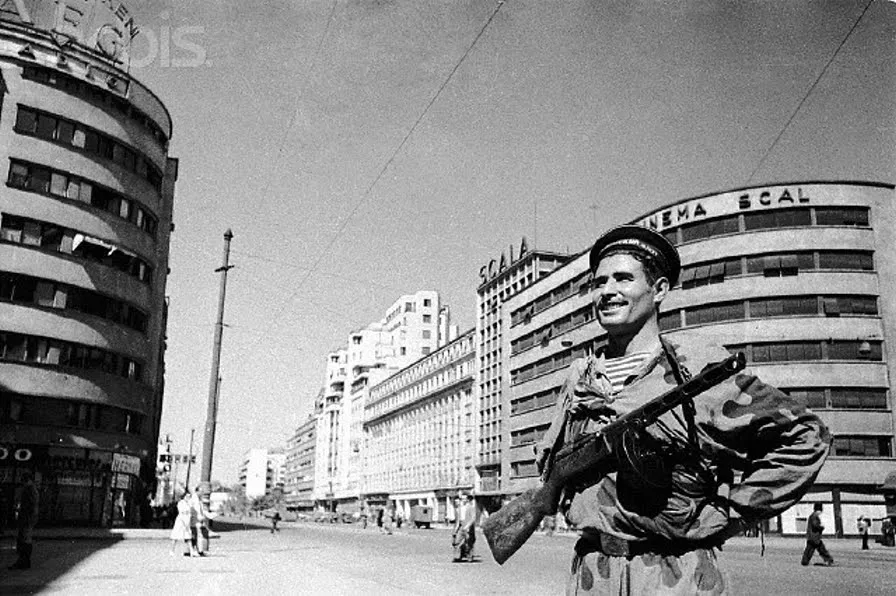 August 1944. A Soviet soldier on Magheru, the Jawol on the left, Cinema Scala on the right — both buildings still in their original interwar livery, just before forty years of grime began. (via bucurestiivechisinoi.ro)
Beyond Magheru
Magheru is the showcase, but the city has at least four or five more quarters where the interwar architects were just as busy — often in smaller buildings, often for private clients, and almost always tucked into residential side streets that no guidebook routes you down. The pleasure of this kind of walk is that you keep turning a corner and finding another one.
The richest cluster is the streets east of Magheru — Negustori, Maximilian Popper, Olari, Hristo Botev, Paleologu, Caimatei — together what’s left of the old Jewish quarter, and Marcel Iancu territory. Iancu — Bucharest-born, packed off to Zurich in 1915 to study architecture, ended up in the back room of the Cabaret Voltaire helping Tristan Tzara, Hugo Ball and Hans Arp invent Dada — came home in 1922 and started building. By 1939 he had put up something like forty apartment blocks and private villas in the city, almost all of them in these streets, almost all of them for Jewish clients. (He left for Palestine in 1941 and never lived here again; his buildings did.) Curved white walls, porthole windows, ship railings on the balconies. He called the Vila Jean Fuchs at Negustori 27 “the first modernist house in Bucharest”; the David Haimovici block on Pictor Verona is the one we usually walk guests to first.
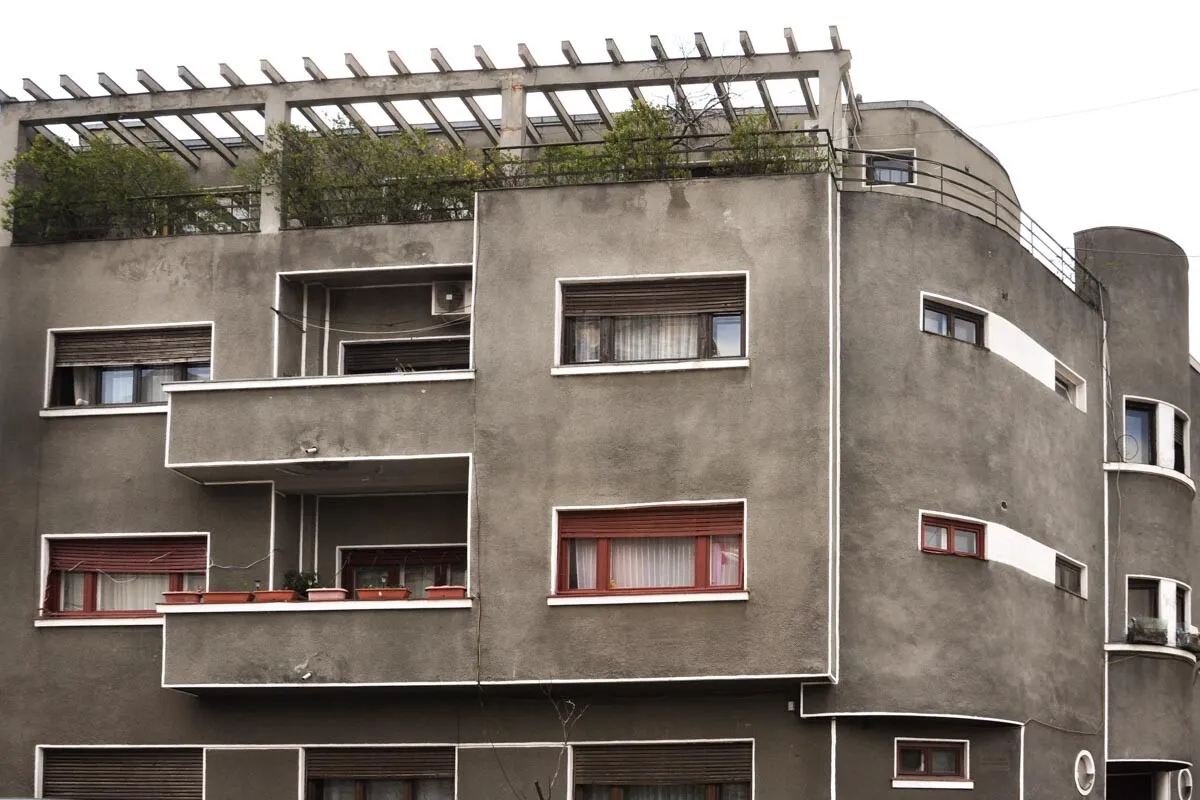 The David Haimovici block — Marcel Iancu, late 1930s. One of about forty he built in these streets
A few streets west, at George Vraca 8 (off Calea Victoriei), the Karmitz Building — Marcel Maller, 1934 — has one of the most distinctive Deco crowns in the city: ziggurat top, three porthole windows running straight down the centre, four vertical glazed slits at the cornice. The Karmitz family commissioned it and gave it their name; from 1937 the ground floor was leased to S.A.R. Drogueria Standard, the country’s largest pharmaceutical company, whose painted signage is still legible in this view taken not long after the building opened. Today it houses the Romanian Ombudsman’s office.
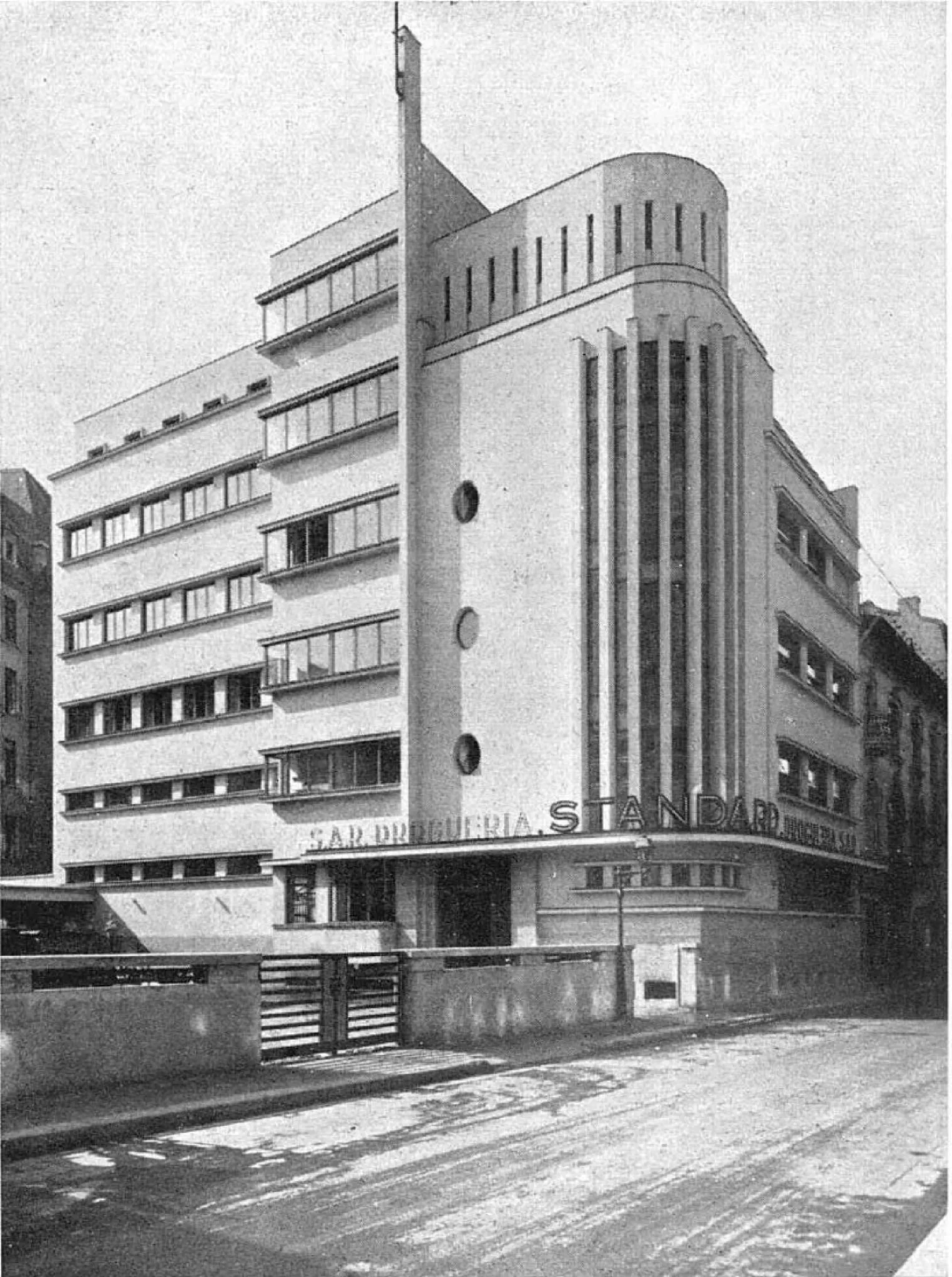 The Karmitz Building (1934) — Marcel Maller. (via bucurestiivechisinoi.ro)
Five minutes’ walk further into the centre, off Bd. Brătianu, Arghir Culina’s first Bucharest landmark stands at Strada Ion Câmpineanu 11. The Hotel Union (1929-31) stacks a cream Art Deco facade up to an astonishing stepped ziggurat crown with UNION picked out in period lettering — pure Manhattan-meets-Bucharest, eight years older than Culina’s own Hotel Ambasador on Magheru, and visibly the more exuberant of the two. Proof that the architect who could build the chastest Streamline Moderne could also, when he wanted, throw an entire skyscraper crown onto a six-storey hotel.
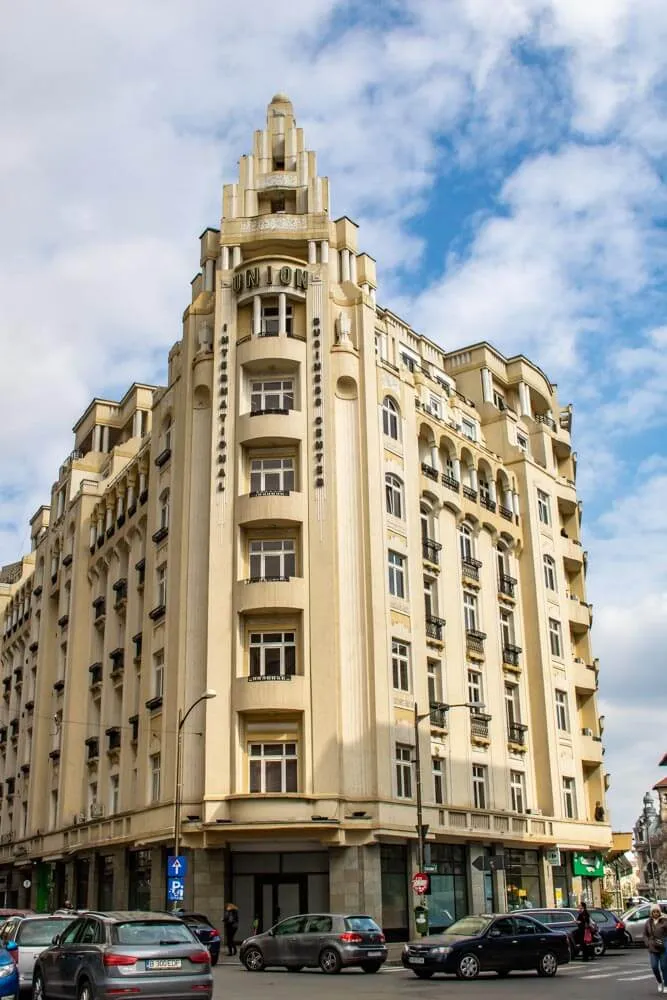 Hotel Union (1929-31) — Arghir Culina's first Bucharest hotel, eight years before the Ambasador
And those are just the buildings I have room to point at. Dorobanți — north of Piața Victoriei, the wealthiest interwar residential quarter — has Horia Creangă’s own villa on Aleea Modrogan and dozens of smaller modernist houses scattered across its tree-lined side streets. Cotroceni, west of Calea Victoriei, mixes pre-war eclectic with 1930s Bauhaus-flavoured villas tucked behind the presidential palace. The Armenească quarter, around the Armenian Cathedral on the eastern edge of the centre, is dense with small apartment blocks from the same five-year window. Up at Piața Charles de Gaulle, where Magheru runs out into the park boulevards, the Bazaltin block — Iancu again — anchors what the locals in 1944 still called Piața Bonaparte. There is at least a week’s worth of walking here if you do one quarter a day, and the list of interwar architects worth knowing — Creangă, Culina, Iancu, Maller, G.M. Cantacuzino, Duiliu Marcu, Ernest Doneaud, Soare Z. Soare — is longer than I have room for in a single post.
The Tel Aviv question
A reasonable question after all that: why isn’t any of this UNESCO World Heritage? A few things at once. Bucharest sits on one of Europe’s worst seismic faults — the 4 March 1977 earthquake brought down 32 buildings in the city centre alone, almost all of them interwar, and many of the ones that didn’t fall now carry red dots (seismic risk class I, the highest). Forty years of communism then left the surviving stock politically suspect and largely unrepaired. And the buildings themselves aren’t what tourists expect to find — visitors come here for the Athenaeum or the Palace of Parliament, not for Bauhaus and Streamline Moderne, so the entire layer goes unseen.
The instructive contrast is Tel Aviv. In 2003 UNESCO inscribed Tel Aviv’s “White City” — about four thousand International Style and Bauhaus buildings, mostly put up in the 1930s and 40s by Jewish architects who had fled Europe. The Bucharest interwar boom is older than Tel Aviv’s by half a decade; the architects had broadly the same training; the architectural language is recognisably the same. One of them is World Heritage. The other has red dots on the doors. Tel Aviv earned its inscription with a thirty-year restoration push that Romania has not yet matched — so it isn’t a contest, but every architecture-loving visitor we get from Israel walks down Magheru and says some variant of we have this at home, we just take care of it. The campaign to get the ARO Building inscribed has been running for a few years now. We will see.
What our guests say
I’ll let some of them speak for me. Goingplaces247 from London (2015) wrote about a “personalised architecture tour highlighting Bucharest’s Art Deco buildings and off-tourist-track sites… totally and warmly recommend.” György from Prague, in 2018, called it the “hidden treasure of Bucharest.” Jackmax1254, two days with Laura in 2023: “good architecture not found in your typical guidebook… love of the place and energy level is contagious.” Avi E from Tel Aviv, also 2018, called what Laura showed him “the most beautiful old houses” — coming from a Tel Avivian, that one registers. JSwagman from Pittsburgh in 2025 wrote that the tour “revealed a vanished Jewish neighbourhood through Art Deco architecture and surviving cultural sites” — which is honestly the right description of what the Iancu and Jewish-quarter side of the walk does. And Eryk R in 2024 said the best part was “the stories behind the urban development.” The buildings on their own are buildings. The reason they exist where they do, when they do, in the shape they do — that’s the story.
Come walk it with us
If any of this sounded interesting — if you want to spend half a day or a full day looking up at this city, talking about Iancu and the ARO and what 1937 felt like — that’s what we do. We have a Bucharest Architecture tour that’s properly built around all of this, and Laura will happily customise it for architects, students, photographers, or anybody who just wants to know why this strange grey city has so much going on underneath the grime.
If you’re still further upstream — wondering whether Bucharest is even worth the trip, or what to actually do here besides look at buildings — those are separate posts.
Most of it is hidden in plain sight. That’s the best part.