
May 20, 2026
Three days is the right amount of time for Bucharest. With less, you will only see the famous monuments and walk away thinking the city is mostly the Old Town and the Palace of the Parliament. With more, you start running out of structured things to do unless you take day trips. Three days lets you do one famous-Bucharest day, one hidden-Bucharest day, and one day that is either a trip out of the city or a deeper second pass at it.
After fourteen years of planning this itinerary in different versions for different guests, here is the version I would build for a first-time visitor with reasonable curiosity, average walking shoes, and no specific theme in mind.
Day 1: The famous Bucharest
Start the morning at Piața Victoriei — the central traffic-circle square that marks the northern end of Calea Victoriei, the city’s historic main boulevard. Walk south. Calea Victoriei is the spine of central Bucharest; in roughly two kilometres it takes you through most of the buildings the standard guidebooks mention.
At about the halfway point you reach the Romanian Athenaeum (1888) — pause for ten minutes outside, longer if it is open. From there walk through Piața Revoluției (Revolution Square), where the December 1989 revolution turned. The square’s two important buildings — the former Central Committee headquarters where Ceaușescu gave his last speech, and the building from which the army fired on protesters — are both still standing. The 1989 memorial obelisk is in the middle.
Continue south down Calea Victoriei to Cărturești Carusel, the white-marble bookstore in the old Chrissoveloni Bank building. Take the photo, then go up to the top floor for a coffee and a quieter view of the Old Town below.
From Cărturești, Stavropoleos is two minutes away — light a candle, sit for five minutes, walk on. Lunch in the Old Town at one of the better places (not Caru’ cu Bere — you can do that for an early dinner some other night).
In the afternoon, walk to the Palace of the Parliament. Take the exterior photo from across Bulevardul Unirii. Skip the interior tour. The story to take in is the building’s relationship to its surroundings: the wide empty boulevard, the enormous void where the Văcărești neighborhood used to be. Walk back via Cișmigiu Gardens — the 1854 city-centre park — and rest your feet there.
If you have one cultural night in Bucharest, this is the night to spend it back at the Romanian Athenaeum for an evening symphony concert. Tickets are inexpensive. The building during a performance is exactly what it was designed for.
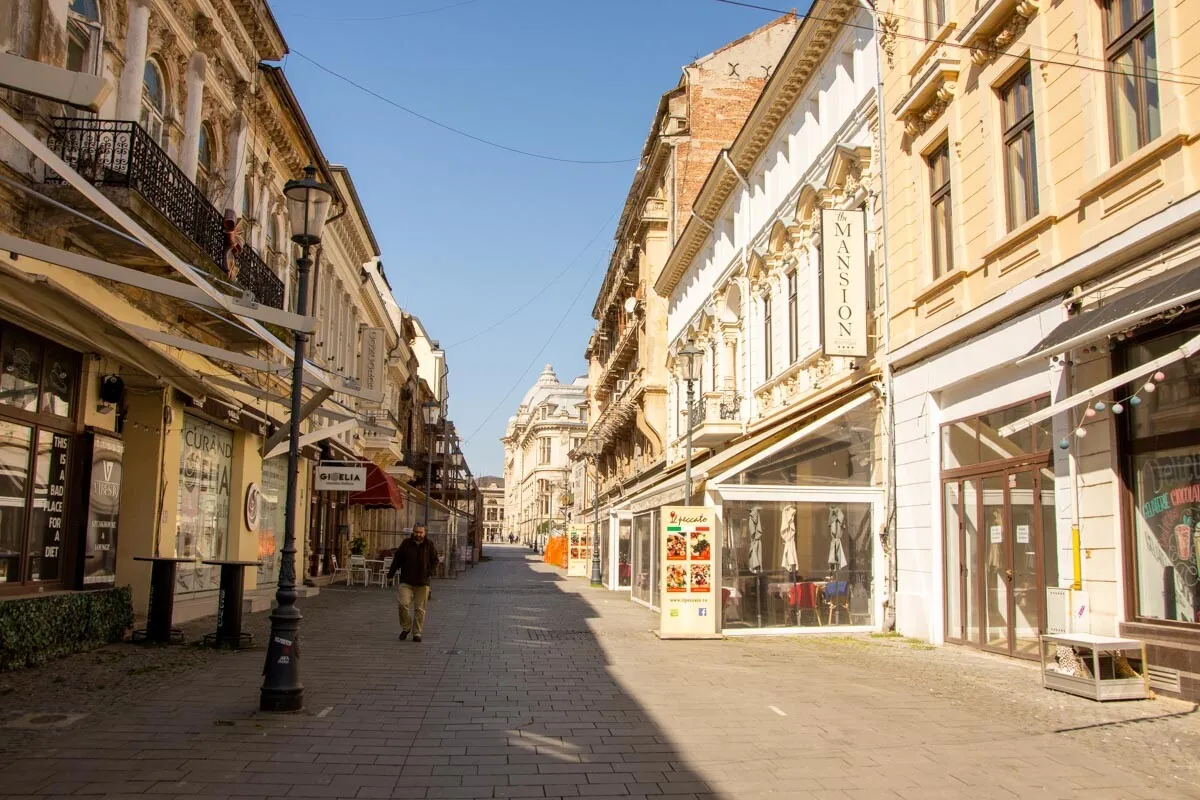 Day 1, late afternoon — the Old Town between lunch and dinner, before the bar crowds arrive.
Day 2: The hidden Bucharest
The second day is the one where the city stops being a sequence of landmarks and starts being a place.
Start with the Magheru Boulevard modernist walk. The pre-war modernist apartment buildings on and around Magheru — designed by Horia Creangă, Marcel Iancu, Duiliu Marcu, and their generation between roughly 1933 and 1940 — are the underrated piece of Bucharest architecture. Most foreign visitors walk past them three times before noticing them. Walking with a guide who can point them out will change how the rest of the city looks to you. You can also do a decent self-guided version with a good architecture book.
Coffee somewhere on Strada Arthur Verona or Strada Pictor Verona — there are two or three third-wave roasters here that have grown up in the last decade.
For lunch, leave the centre. Cotroceni, Dorobanți, or Floreasca are the residential neighborhoods where Bucharest residents actually eat. The restaurants are not in any guidebook and rotate too fast to recommend specific names that will still be open in a year — but any decent one will give you the version of Romanian food the centre doesn’t.
In the afternoon, pick one:
- The Jewish heritage half-day walk — Choral Temple, Great Synagogue, Yiddish Theatre, with the lost Văcărești neighborhood explained on the way. The single most distinctive specialist tour in the city.
- Bellu Cemetery — Bucharest’s “Père Lachaise,” where most of Romania’s important nineteenth- and twentieth-century writers, painters, and politicians are buried. Quiet, neglected in the best way, the chapels and sculpted graves repay an hour of slow walking.
- Therme Bucharest — the large spa complex about thirty minutes north of the centre, useful if it is winter and your knees have given up.
Dinner at Lacrimi și Sfinți in the Old Town (see the food guide) or at a place a Bucharest friend has told you about in Floreasca.
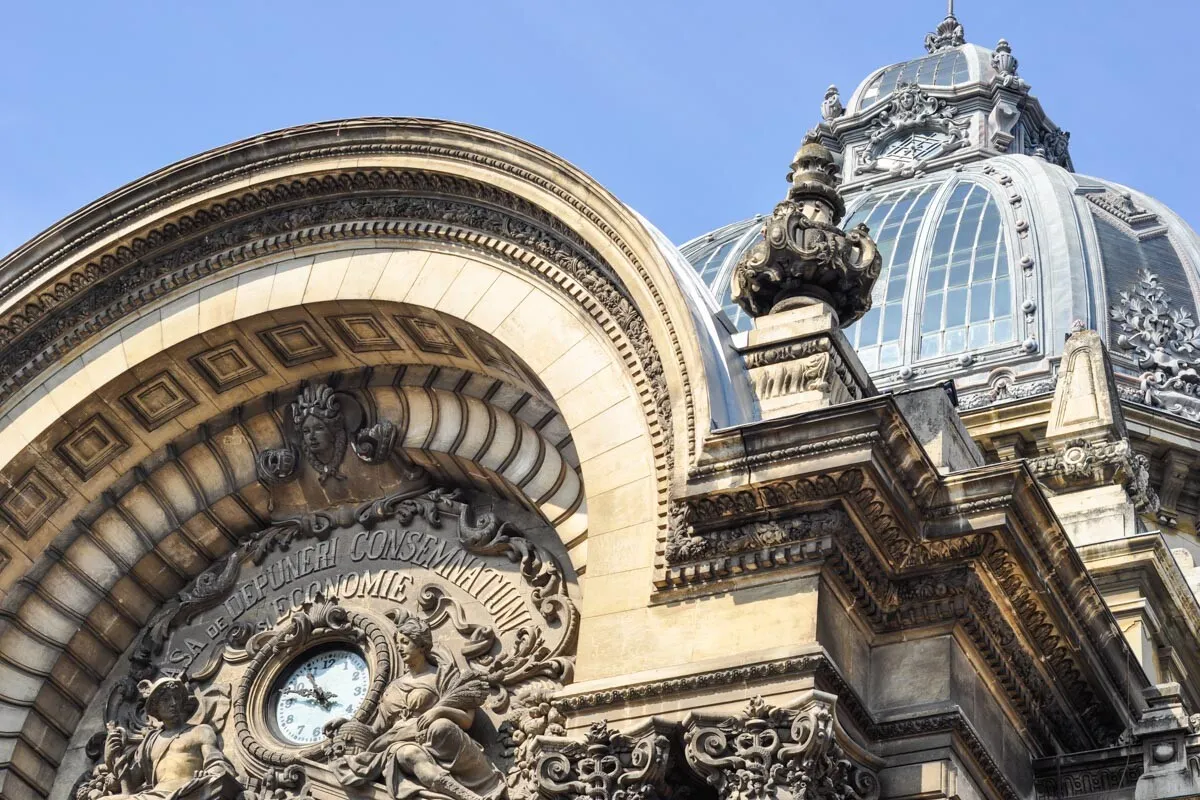 Day 2, Belle Époque detail — the kind of facade you walk straight past unless someone points at it.
Day 3: Out, or deeper
The third day is the one that depends on what you came for.
If you want the famous day trip: Peleș Castle in Sinaia is two hours north in the Carpathian foothills. The late-nineteenth-century Neo-Renaissance summer residence of the Romanian royal family has one of the best-preserved interior ensembles in this part of Europe — German oak, Italian marble, Venetian glass, more than 160 rooms. Combine it with a brief stop at Bran Castle on the way back if you want the Dracula photograph (be warned: Bran has very little to do with the novel).
If you want the less touristy day trip: what we call a village day — out into the Prahova or Carpathian foothills with lunch in a local home, an hour or two of countryside, and a horse-cart ride through the village. Several of our guests in recent years have written that this was the highlight of the trip — not because the castles aren’t worth it, but because the village experience is what you cannot do anywhere else in Europe.
If you want to stay in the city: combine the food tour (half-day, lunch built in) with the Jewish heritage walk (afternoon) for a day that is essentially the deepest version of what Bucharest does well — local conversation, real meals, and a heritage the demolitions did not entirely succeed at erasing.
What to under-do
Do not try to fit the Parliament interior tour, the Village Museum, the Therme spa, and a day trip into the same three days. Pick two of those at most. The city rewards slow walking and falls flat under a schedule.
Do not eat dinner in the Old Town two nights in a row.
Do not try to “do” Bellu Cemetery and Cișmigiu and Carol Park in one afternoon. Pick one. They each repay an hour.
Do not skip the Athenaeum concert if there is one running while you are there. Three days in Bucharest without one evening in that building is a small specific kind of waste.
The version that lands best
The version of this itinerary that ends up working for most guests is roughly: famous day → hidden day → village day. Architecturally that is the order of intensification — they move from the things they recognize to the things they will only see here. Most of them leave reluctant to leave. That is what three days in Bucharest is supposed to do.
If you’d like us to plan a custom version, we’d be glad to.