
May 20, 2026
One of our TripAdvisor reviews from October 2023 captures the version of this tour that is hardest to plan for and easiest to remember. A guest of ours called Michael had booked the half-day Jewish heritage walk and arrived to find that most of the sites we visit on it were closed that day. Laura, his guide, did not cancel. She made three phone calls. By the time the tour started she had arranged for Michael’s group to meet Gil at one site, then Mr. Galateanu at the second, then Mr. Marcel at the third — community members who unlocked their doors, sat down with the guests, and answered the questions a guidebook never quite does. Michael wrote afterwards that despite the closures he got “the full experience.” Laura’s reply on TripAdvisor, addressed to him by name and listing the three people, has stayed with me.
That is the tour at its best. It is the version that depends on Bucharest’s Jewish community still being a community. Most days a version of it is possible. Some days it isn’t. This is one of the few tours where the people matter more than the buildings — which is fitting, given how much of the original neighborhood is gone.
What was here before
In 1930, the last full census before the war, Bucharest had roughly 76,000 declared Jewish residents — about 11 percent of the city. Most lived in a network of dense, mostly working-class streets in the southeast of the centre, on and around Calea Văcărești, between the present-day Unirii Square and what is now Vasile Lascăr Street. There were dozens of synagogues, several Jewish hospitals, the headquarters of the Federation of Romanian Jewish Communities, schools that taught in Yiddish and Romanian, kosher restaurants, two Jewish theatres, half a dozen Jewish newspapers. The community was old. The first documented Jewish presence in Bucharest is from the sixteenth century; by 1900 the city had one of the largest Jewish populations in southeastern Europe.
Two things destroyed almost all of this.
The first was the war. Romania’s wartime treatment of its Jewish population was not the German final-solution version, but it was not the rescue story sometimes implied either. Between 1941 and 1943, Romanian forces and gendarmes carried out the Iași pogrom of June 1941 (around 13,000 dead in three days) and deported approximately 150,000 to 250,000 Jews from Bessarabia, Bukovina, and Dorohoi County to camps in Transnistria, where most of them died of starvation, disease, exposure, and direct violence. The total death toll of the Romanian-perpetrated Holocaust, established by the Wiesel Commission in 2004, is between 280,000 and 380,000 Jews.
The Bucharest community itself mostly escaped this. In January 1941, the Iron Guard’s failed coup attempt produced a three-day pogrom in the city that killed around 125 Jews and destroyed much of the Văcărești neighborhood. After Antonescu suppressed the Iron Guard and consolidated power, the Bucharest community was harassed and stripped of property but largely not deported. In 1942 the regime drew up — and then, after months of internal debate, refused — a plan to ship the remaining Bucharest Jews to the German death camp at Bełżec. The community leader who negotiated the refusal was Wilhelm Filderman, the head of the Federation of Romanian Jewish Communities and a man whose archive is still being read by historians.
The second thing was Ceaușescu. Between 1984 and 1986, in clearing ground for the Civic Centre and the Palace of the Parliament, the regime demolished the entire Văcărești neighborhood — synagogues, houses, schools, the small streets that had given the community its texture. What survived survived because it was outside the demolition zone or because someone protested loudly enough. Most of the original Jewish Bucharest is now a wide, mostly empty boulevard.
The community itself was hollowed out separately. Between 1948 and the late 1980s, Romania allowed Jewish emigration to Israel in exchange for hard currency from the Israeli government — an arrangement Israel paid for both per person and per profession. About 200,000 Romanian Jews left this way. Today Bucharest’s Jewish community is estimated at three to four thousand active members.
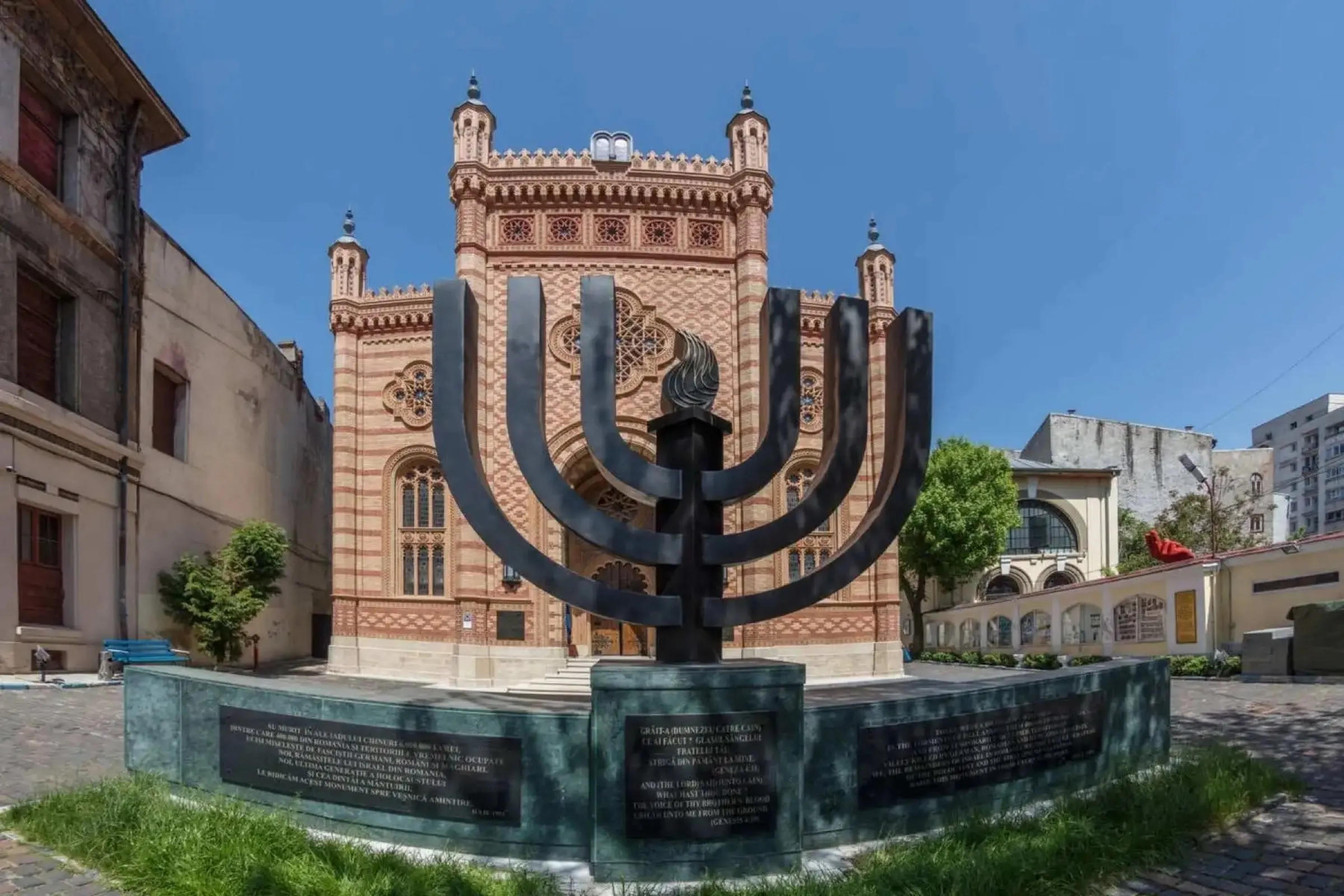 The Choral Temple — the largest active synagogue in Bucharest, restored in stages over a hundred and sixty years.
What you can still visit
Three sites form the spine of any half-day Jewish tour.
The Choral Temple (Templul Coral, on Strada Sfânta Vineri) is the largest active synagogue in Bucharest. Built in the 1860s in a Moorish revival style modeled on Vienna’s Leopoldstadt-Tempel, partly destroyed by the Legionnaires in January 1941, restored, partly damaged by Ceaușescu’s demolitions in the 1980s, restored again. Services still happen here. The building’s interior — galleries on three sides, an elaborate Torah ark, a domed ceiling repainted in stages over the past thirty years — is the single most visually arresting Jewish space in the city.
The Great Synagogue (Sinagoga Mare, on Strada Vasile Adamache) — historically known as the Polish Synagogue, because it was built in the 1840s by Bucharest’s Polish-Jewish Ashkenazi community — now houses the museum of the Romanian Holocaust. The building is plainer than the Choral Temple, the exhibition is dense, the staff are knowledgeable, and the experience is unrushed in a way that the official Holocaust museums in larger cities have lost. Entry is by donation.
The State Yiddish Theatre (Teatrul Evreiesc de Stat, on Strada Iuliu Barasch) is one of the few continuously operating Yiddish-language theatres still in the world. It was founded in 1948 and has performed without interruption since. The current season includes plays in Yiddish, in Romanian translation, and some in Hebrew. Several of our guests over the years have arranged in advance to attend a performance; almost all of them describe it as the unexpected highlight of the trip. This is the venue that one of our 2025 reviewers mentioned Laura phoning ahead to have opened on a day it was closed to the public.
Beyond the three is the Holocaust Memorial, on a small square near Dambovita river, designed by the Romanian-German sculptor Peter Jacobi and unveiled in 2009. It is small, restrained, and easy to walk past without noticing — which is partly the point.
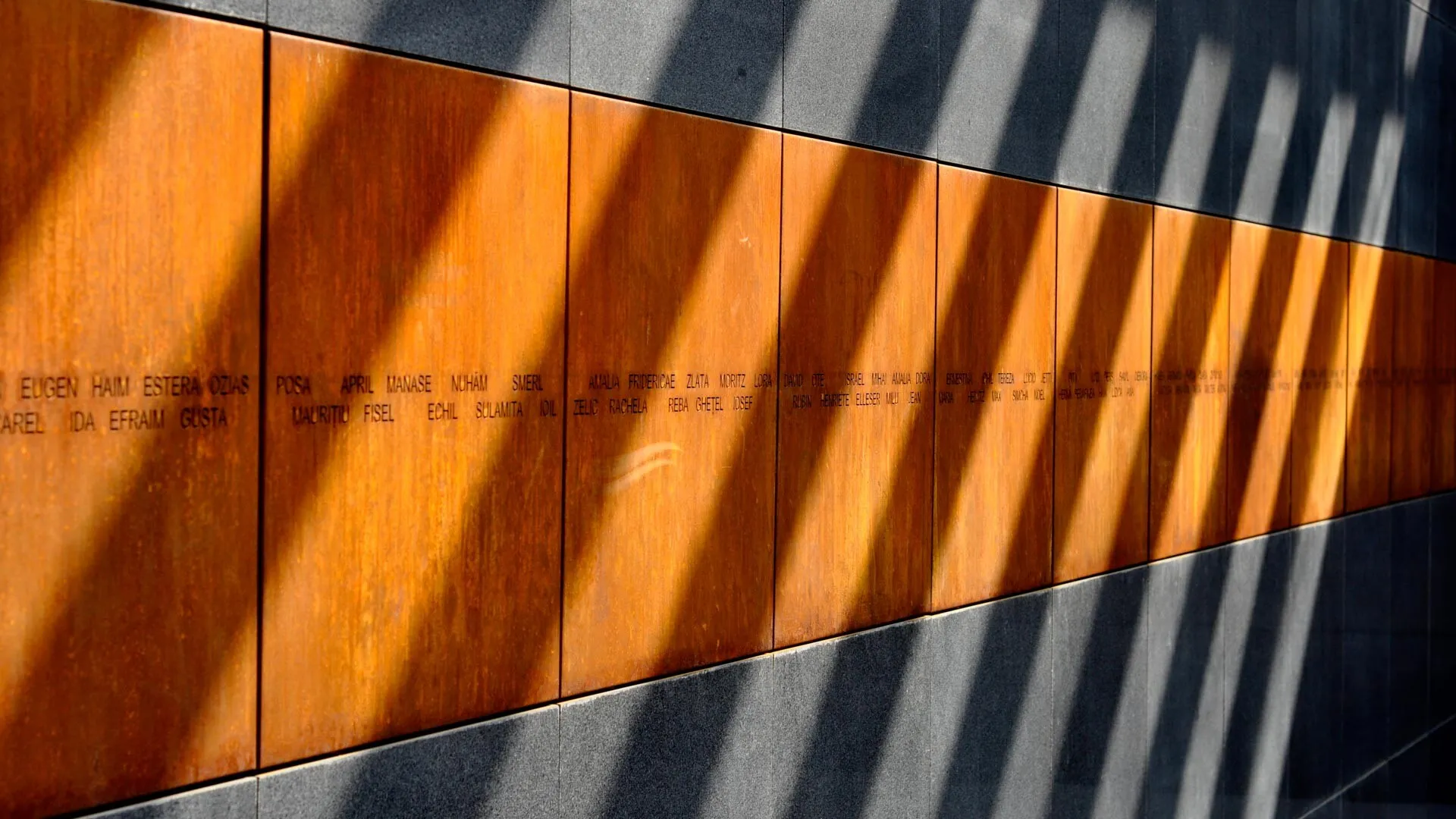 The Holocaust Memorial off Calea Călărași — Peter Jacobi, 2009.
The people who came from this community
Several of the modernist architects whose buildings now define inter-war Bucharest were members of this community. Marcel Iancu — known abroad as Marcel Janco — was born here in 1895, co-founded Dadaism in Zurich in 1916 with Tristan Tzara (born Sami Rosenstock in Moinești), came back to Bucharest, and designed roughly forty buildings here between the late 1920s and 1941, including the David Haimovici building and the Solly Gold villa I mentioned in the worth-visiting post. Tristan Tzara stayed in France, but came from this same milieu. So did the novelist Mihail Sebastian (Iosif Hechter), whose Bucharest diaries from 1935 to 1944 — published only after 1989 — are now translated into more than a dozen languages and are one of the indispensable documents of European fascism. The cultural footprint of pre-war Romanian Jewry is enormous. The physical footprint in Bucharest is almost gone. The two facts have to sit next to each other.
What walking it actually feels like
Quieter than you expect. Sundays especially. The Choral Temple sits two minutes from a busy office street and from inside you cannot hear it. The Great Synagogue museum has the unhurried weight of a building that has had to be its own caretaker for a long time. The Yiddish Theatre’s small box office has playbills going back decades on the wall behind the seller’s head.
For some guests — especially those with family histories that touched Romania — the tour becomes personal in a way it is not for others. We have had visitors find synagogues their grandparents were married in. We have had visitors find streets that no longer exist where the family house used to be. We have had visitors come without any family connection and leave moved anyway, mainly by how thoroughly an entire urban world can be erased and how stubbornly small pieces of it remain.
A guide matters for this tour more than for any other we run, because the community contacts — the Gils and the Mr. Galateanus — are not findable in any guidebook and the synagogues do not always keep predictable hours. If you would like us to make the calls, we’d be glad to walk you through it.